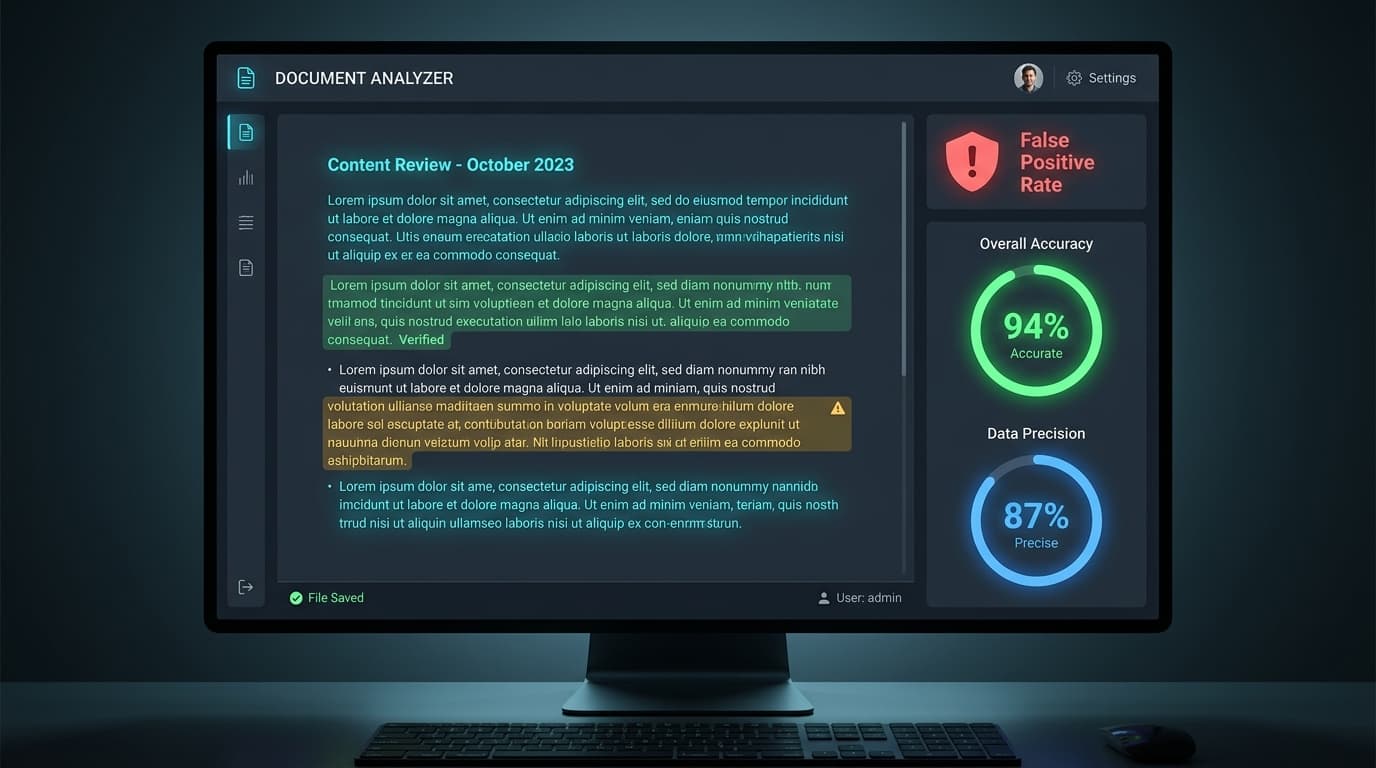
Direct Answer: Turnitin claims an AI writing detection accuracy rate of 98%. However, independent academic testing reveals that the actual turnitin ai detection false positive rate is between 1% and 4%. This means that for every 100 human-written essays submitted, up to 4 papers will be incorrectly flagged as AI-generated, which has raised significant concerns about student fairness.
When Turnitin launched its AI detector, it promised a reliable method to identify generative writing. Since then, the tool has processed millions of assignments. But as AI models evolve from ChatGPT to more advanced writing assistants, the debate over detector accuracy has intensified.
For students and writers, a single false positive flag can damage reputations and grades. Let's analyze Turnitin's accuracy claims, examine the false positive rate, and explore how universities are handling these results.
Turnitin's Official Accuracy Claims
Turnitin asserts that its AI detection model is highly refined. According to their official statements:
- The system operates with 98% overall precision across full documents.
- The false positive rate is under 1% when assessing entire papers.
- The detector is specifically optimized to avoid flagging human writing, preferring to under-detect rather than generate false alarms.
Despite these assertions, independent studies paint a more nuanced picture.
The False Positive Rate: What Independent Studies Reveal
A false positive occurs when the detector highlights human-written text and claims it was generated by an AI writer. In real-world university trials, accuracy rates have shown deviations:
- Vanderbilt University Testing: Academic technology specialists at Vanderbilt conducted tests and discovered that Turnitin's detector generated false positive flags at a higher rate than advertised, leading the university to disable the feature.
- Simplified Sentence Structures: Classifiers analyze perplexity (vocabulary choice) and burstiness (sentence variation). If a human writes with clean, simple, or highly structured sentences, the system will flag the text as predictable AI writing.
- The Non-Native Speaker Penalty: A study by Stanford researchers found that AI writing detectors falsely flagged essays written by non-native English speakers as AI-generated in over 60% of cases. The limited vocabulary and uniform phrasing standard in ESL writing trigger the detector's thresholds.
Factors that Reduce AI Score Accuracy
Several common elements can corrupt the accuracy of Turnitin's AI score:
- Short Submissions: Turnitin requires at least 300 words of prose to analyze writing style. Submitting short answers, bullet points, or codes results in highly inaccurate, random flags.
- Grammar Checkers: Heavily running your work through automated editors (like Grammarly) can trigger false positives. These tools suggest modifications to make sentences concise and uniform, which mimics the low burstiness of AI models.
- Mixed Authorship: If a document contains a mix of human text and small AI-assisted outlines, the detector struggles to isolate the boundaries, sometimes highlighting the entire section.
How Universities Are Responding to AI Scores
Because an AI score is based on probability rather than definitive proof, academic institutions are divided on how to use it:
Many major US and UK colleges have disabled Turnitin's AI detector entirely. Tutors are instructed not to use the AI percentage score as the sole basis for plagiarism disciplinary cases, treating it as an advisory marker rather than concrete evidence of cheating.
How to Protect Yourself from False AI Flags
If your college uses Turnitin and you want to ensure your original work is not flagged:
- Keep Revision Histories: Write your assignments in applications that track revision histories (like Google Docs or Word). If flagged, you can play back your writing process as proof.
- Write with Natural Voice: Vary your sentence structures. Use parenthetical remarks, transition phrases, and specific personal anecdotes that AI models rarely produce.
- Pre-Check Privately: Use a client-side custom Turnitin report generator to check your draft score privately before uploading it to Canvas, helping you adjust your writing style if it triggers accidental flags.
Frequently Asked Questions
Can Turnitin AI detection be wrong?
Yes. Turnitin's AI detector has a documented false positive rate of 1% to 4%. It can flag clean human writing, particularly if the author is a non-native English speaker or writes in a highly structured style.
What happens if Turnitin flags my essay as 100% AI?
Your professor will likely request a meeting. If you wrote the essay yourself, you can prove it by showing your research drafts, source outlines, and the document's edit history.
How do I bypass Turnitin AI detection?
The safest way is to write in your own natural voice. Evasion tricks like character-swapping or bypass software are easily flagged by Turnitin's system and will alert your instructor.
Verify Your Scores Before Submitting
Ensure your paper is safe. Check out our guide on does Turnitin's AI detector work and test your file using our free generator today.