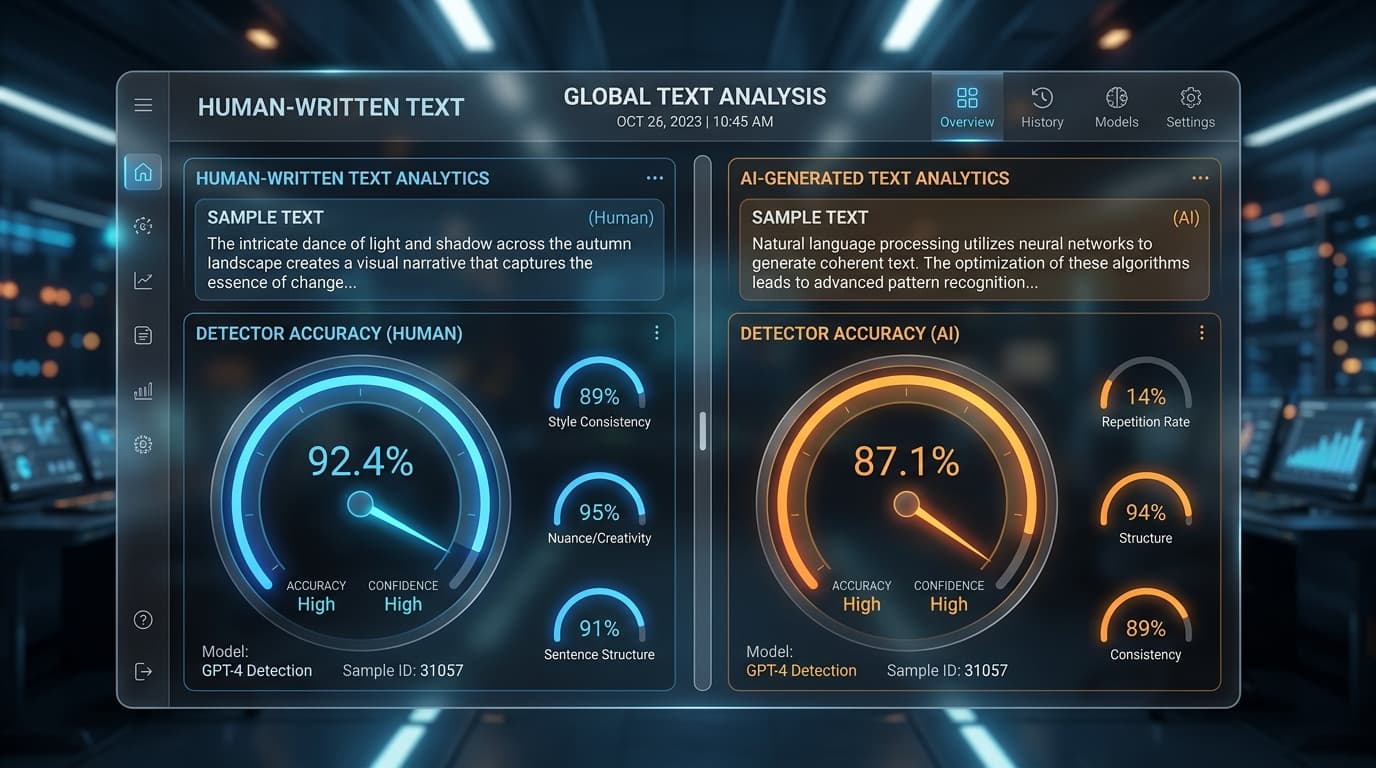
Direct Answer: Yes, Turnitin's AI detector works, but its **turnitin ai detector accuracy is not 100%**. Turnitin claims a **98% confidence level** in identifying AI-generated writing from models like ChatGPT, Claude, and Gemini. However, independent research and university reports indicate a false positive rate (incorrectly flagging human work as AI) of **1% to 4%**, which has led several major US universities to disable the AI detection feature.
Since Turnitin launched its AI writing detection feature, it has become one of the most controversial topics in higher education. With the release of GPT-4, Claude 3.5, and advanced writing assistance tools, students are increasingly worried about being falsely accused of academic misconduct.
Let's analyze how Turnitin's AI detector works under the hood, what its actual accuracy rates are, and how you can prevent false positives in your submissions.
How Turnitin's AI Writing Detector Works
Unlike traditional plagiarism tools that compare text to a database, Turnitin's AI detector uses a classifier model trained to recognize the specific patterns of AI text generator models (ChatGPT, Claude, Gemini). It analyzes two key metrics of your writing style:
- Perplexity: This measures how predictable the words in your text are. AI models are trained to select the most statistically probable next word, resulting in very low perplexity. Human writing features high perplexity, with unexpected word choices and creative sentence structures.
- Burstiness: This measures the variation in sentence length and structure. Humans write with natural “bursts” — a mix of short, punchy sentences followed by long, complex clauses. AI models write with very uniform sentence lengths and structures, creating low burstiness.
If a passage features both low perplexity and low burstiness, Turnitin's classifier flags it as AI-generated and highlights it in a separate AI Originality report interface.
The Accuracy Debate: Claims vs. Reality
Turnitin publishes official claims that its detector works with high precision:
- 98% accuracy on document-level submissions.
- A **false-positive rate of less than 1%** for complete documents.
However, studies from universities like Vanderbilt, Northwestern, and the University of Texas have shown that in practice:
- Higher False Positives on Non-Native English Writers: Research shows that AI detectors flag writing by non-native English speakers at a rate of up to **61%**. Because non-native writers tend to use simpler, more predictable sentence structures, classifiers mistake their human writing for AI.
- Short Text Is Unreliable: Turnitin requires at least 300 words to evaluate AI writing. Anything below this threshold cannot be accurately checked and is prone to false flags.
- Evasion via Paraphrasing: Human rewriting, mixing sentences, or using paraphrasing tools can lower the AI score, showing that the tool can be bypassed by edited AI text.
Why Some US Universities Have Disabled the AI Detector
Due to the risk of false accusations, several major US colleges (such as Vanderbilt University and the University of Alabama) have officially turned off Turnitin's AI detection features on their portals.
They cite that because AI detectors cannot provide definitive proof — only statistical likelihoods — using them to penalize students is ethically risky. Despite this, thousands of other colleges still keep the detector active.
How to Prevent Accidental AI Flags (False Positives)
If you write your own papers but rely on Grammarly for editing, or if you write in a structured academic style, you can take these steps to protect your work:
- Maintain a Version History: Write your paper in Google Docs or Microsoft Word with OneDrive auto-save active. If a professor flags your paper as AI, you can show your step-by-step editing history as definitive proof of human creation.
- Avoid Excessive Editing Assistants: Tools like Grammarly or Microsoft Editor can simplify sentences to make them more concise. Over-optimizing your text makes it look predictable, which can trigger AI flags.
- Use Diverse Sentence Lengths: Mix short, medium, and long sentences deliberately. Add parenthetical notes, personal reflections, and custom examples.
- Pre-Check Your Draft: Use a client-side custom Turnitin report generator to check your draft score privately before uploading it to Canvas.
Frequently Asked Questions
Can Turnitin detect paraphrased AI text?
It depends on the level of editing. If you use a simple tool to swap words, yes — the underlying sentence rhythm (burstiness) remains predictable. If you rewrite and restructure the text completely, the score will drop significantly.
What is a false positive in Turnitin AI detection?
A false positive occurs when Turnitin's detector incorrectly flags human-written text as AI. This typically happens if the writing style is highly formal, formulaic, or written by a non-native English speaker.
How can I prove to my professor that I didn't use AI?
Show them the version history of your document, share your research outlines, show the sources you cited, and offer to walk them through the logic of your arguments in person.
Verify Your AI Score Privately
Don't let false positive flags jeopardize your grades. Get your draft score ahead of submission. Check out our guide on how custom Turnitin percentages work and run your file through our private tool today.