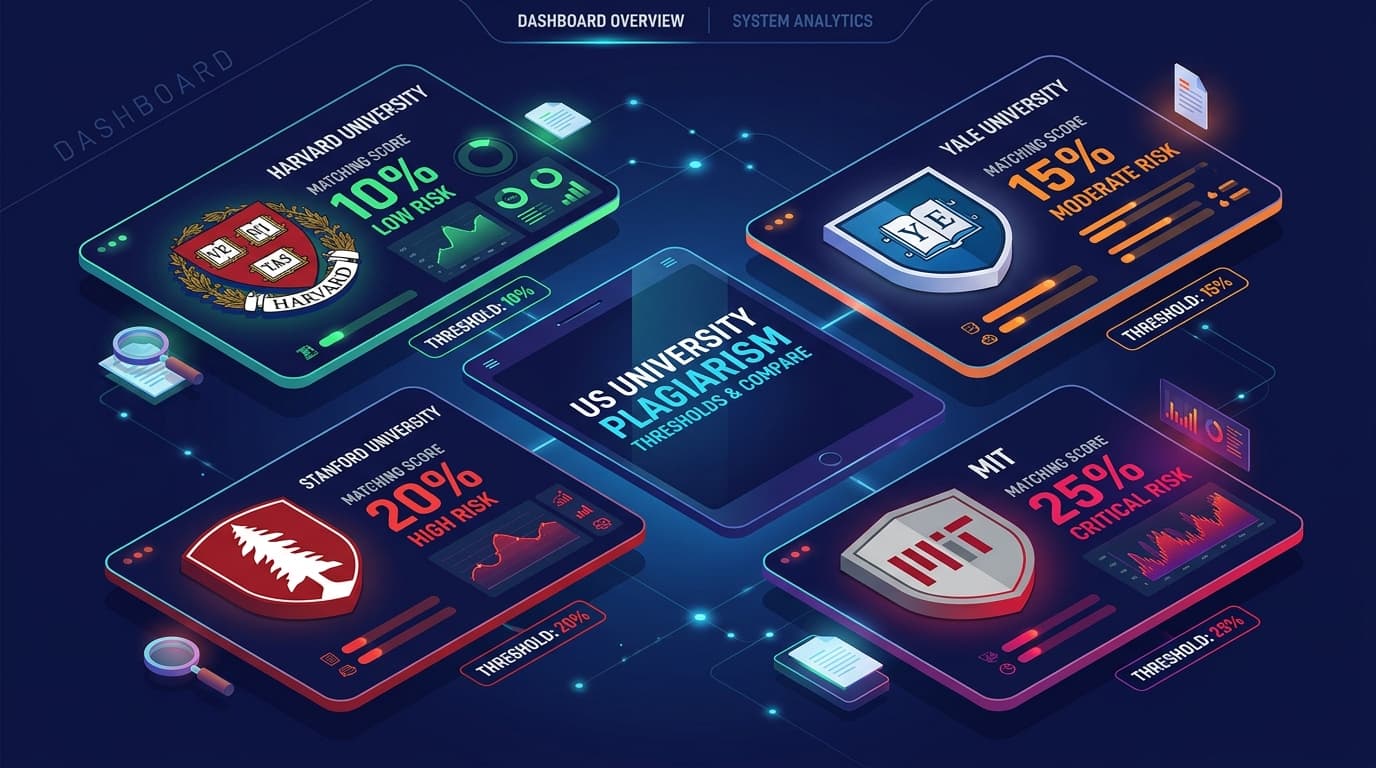
Direct Answer: There are no official, centralized turnitin similarity score requirements us university boards publish. Instead, individual professors and departments establish their own guidelines. As a general industry standard, an acceptable plagiarism percentage us college departments enforce is **15% to 20%** or lower. Any score higher than 20% typically triggers manual review by tutors.
When submitting essays through Canvas or Blackboard portals in US colleges, you will see a colored badge showing a similarity percentage. The immediate worry for any student is: "Will my score get flagged?" and "What are my university's specific limits?"
To answer this clearly, you must understand that Turnitin is a tool for interpretation—not a black-and-white judge. US universities do not set strict, automated thresholds across the entire institution. Let's analyze how colleges interpret these scores, what departmental variations exist, and how you can ensure your papers fall safely within the acceptable ranges.
Why Do Universities Not Set a Universal Similarity Limit?
Many students expect colleges like Harvard, Stanford, or Yale to have a published handbook saying: "All submissions must score below 15%." Such rules do not exist. If they did, it would create unfair grading issues:
- The Boilerplate Problem: In computer science, coding tasks require specific libraries or function outlines that everyone must write identically. A student could easily score a 25% match purely on boilerplate code, while the core logic is 100% original.
- The Citation Problem: An essay researching historical texts will naturally have a higher similarity score due to quotes from primary documents compared to a creative writing project.
- Academic Discretion: Professors maintain absolute grading authority. They prefer to look at what is highlighted rather than just checking the number.
Typical Plagiarism Limits by Department
While there is no institutional rule, departments generally operate within these informal threshold guidelines:
1. Humanities and Literature (Strict Limits: Under 10-15%)
In English, History, Philosophy, and Creative Writing, you are expected to analyze concepts using your own unique voice. Because these fields rely on subjective explanation, matching scores should be low. If your score exceeds 15%, professors will look closely at whether you paraphrased properly.
2. Engineering, Coding, and Mathematics (Moderate Limits: Under 25%)
Because formulas, math derivations, and software libraries use identical strings, these departments allow a higher similarity index. Matching scores up to 25% are often normal in STEM assignments, provided the original commentary and results are unique.
3. Sciences, Biology, and Medicine (Moderate Limits: Under 20%)
Scientific definitions, chemicals, and lab procedures follow standard phrasing. These reports are allowed up to 20% match. However, results, analyses, and abstract sections must be completely clean of matches.
Understanding the Turnitin Color Indicators
Turnitin displays a color code alongside your percentage score. Here is what professors see:
- Blue (0% matches): No matching words found. While it sounds perfect, a 0% score can sometimes look suspicious, indicating that the text might have bypassed the scanner using format tricks.
- Green (1% to 24% matches): The standard zone. This indicates normal academic referencing, templates, and common phrases.
- Yellow (25% to 49% matches): The warning zone. Tutors will inspect the report to check if the student quoted heavily or forgot citation tags.
- Orange (50% to 74% matches): High alert. This suggests significant blocks of text are matches.
- Red (75% to 100% matches): Severe match. The paper is likely fully plagiarized or duplicated.
How to Prevent False Similarity Alarms
To ensure your paper meets the informal acceptable plagiarism percentage at your US college, follow these practices:
- Exclude Bibliographies: Ensure you ask your professor if reference exclusions are active. This prevents your references from inflating your score.
- Format Direct Quotes: Wrap quotes in quotation marks to trigger the quotes filter.
- Check Prior to Submission: Run your file through a secure, sandbox generator to verify there are no accidental copy-paste matches.
Our client-side free Turnitin report generator helps you preview report structures and check your document layout privately before uploading to Canvas or Blackboard, keeping your record clean.
University Requirements FAQs
What is an acceptable Turnitin similarity score at US colleges?
Most professors accept scores under **15% to 20%**. However, any amount of uncredited matching text (even 1%) is considered plagiarism, so focusing on accurate citation is more important than the overall number.
Can you fail Turnitin with a green score?
Yes. If a report has an overall green score of 12%, but that 12% is a single page of text copy-pasted directly from another student's paper without a citation, it is plagiarism and can lead to failure.
How does a custom Turnitin report help?
A custom report lets you see how highlights, layout formats, and metadata look under different target percentages. It acts as an educational preview to help you structure your document safely.
Conclusion
There is no universal limit, but keeping your score under 20% through ethical paraphrasing and citing is key to academic success. Read our details on do US colleges require Turnitin or generate a custom preview report to inspect your formatting today.