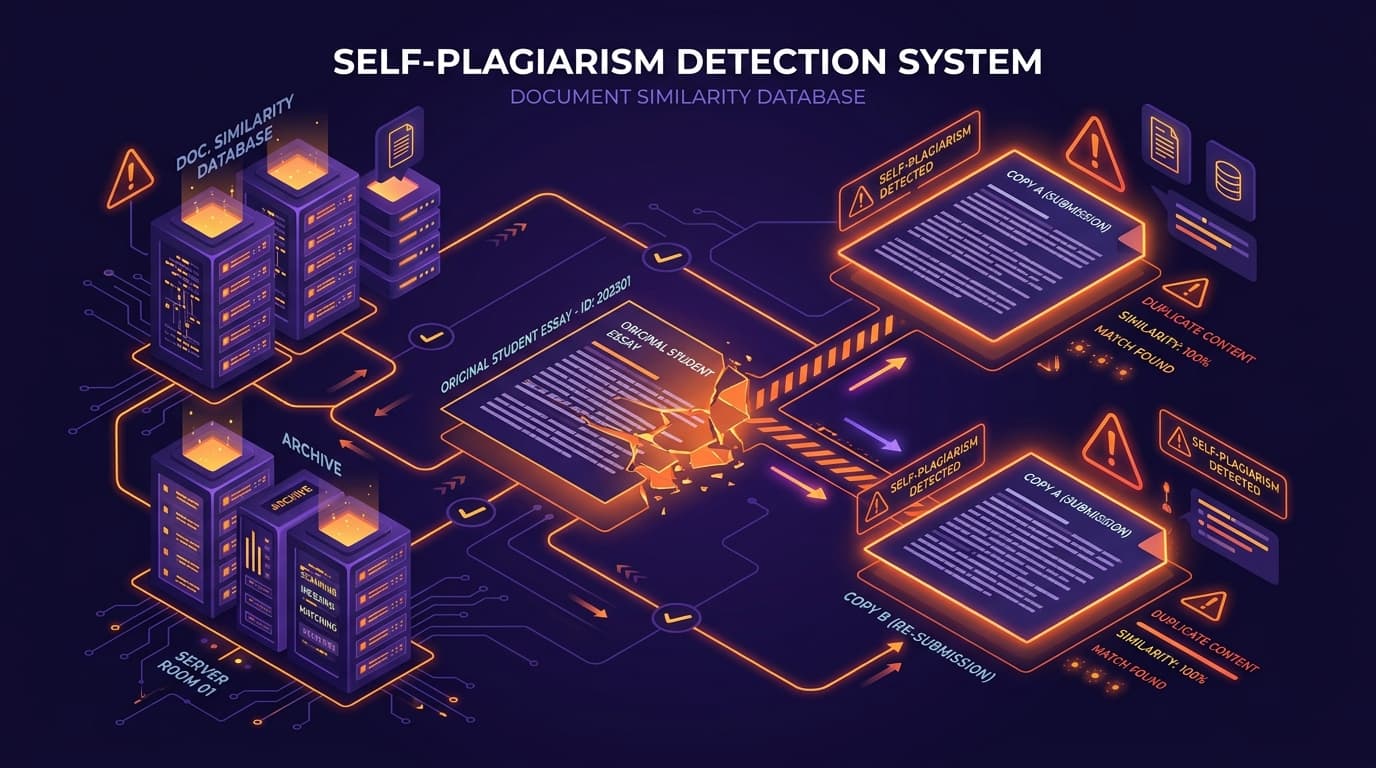
Direct Answer: Yes, you can get flagged by Turnitin for reusing your own past work. This occurs because Turnitin indexes all submitted documents inside its global student paper database. When you upload a new paper containing sections or paragraphs from your past assignments, the self plagiarism turnitin matching algorithm will identify it as a duplicate, resulting in a high similarity flag.
Many students are surprised to discover that recycling their own writing can lead to academic integrity issues. After all, if you wrote the words yourself, how can it be considered stealing?
In academic publishing and higher education, reusing your own work without citation is termed **self-plagiarism**. Let's explore how Turnitin's databases function, why universities forbid recycling work, and how you can ethically build on your previous research.
Why Reusing Own Work Plagiarism Checker Flags Occur
To understand why Turnitin flags your recycled work, you have to understand its database mechanics. When you submit a paper through Canvas, Blackboard, or directly via an institutional account:
- The document is analyzed for immediate matches.
- By default, your document is stored and archived in Turnitin's Student Paper Database.
- The next time any student (including you) submits a paper containing identical blocks of text, the engine matches it against that archived copy.
Because the database registers the previous file under a separate submission ID, it cannot automatically verify that you are the author of both papers. It simply highlights the overlap as duplicate content.
Is Self-Plagiarism Actually Cheating?
Yes, in an academic context, recycling papers is generally considered a violation of integrity policies. Most US, UK, and European universities have guidelines stating that students cannot submit the same work for credit in two different courses.
Academic credits are awarded for new learning and new research. Submitting a paper you wrote last year for a new course is viewed as circumventing the learning process, which is why teachers enforce strict limits.
How to Ethically Reuse Your Own Research
If you are working on a long-term research project, writing a graduate thesis, or expanding on a topic you studied in a previous semester, you can reuse your findings ethically by following these guidelines:
1. Cite Your Previous Work
Treat your past essays like a third-party source. If your previous paper was published in a university archive or submitted for class credit, cite it in your bibliography:
"According to my preliminary findings on soil dynamics, acidity levels drop under shade (Doe, 2025)."
This alerts your teacher that you are building on your own previous work, rather than passing it off as brand new research.
2. Obtain Permission from Your Professor
Always talk to your current instructor before submitting a paper that builds on past work. Explain that you would like to expand on your previous research. Most instructors will approve this, provided you add significant new analysis, data, or arguments.
3. Paraphrase Yourself completely
If you must refer to concepts you explained in a previous essay, rewrite them entirely. Reorganize the sentence structures and vary the vocabulary so the text does not trigger consecutive string matches on a plagiarism scanner.
Safe Checkers vs. Institutional Databases
Because of database archiving, you must be extremely cautious when checking your drafts online. If you upload your essay to a public plagiarism checker to test your score, and that checker indexes your document, your official university submission will score a **100% similarity match**.
Our free Turnitin report checker is a sandbox tool. It processes your PDF entirely within your browser (client-side processing). Your files are **never** stored on our servers, never shared with Turnitin, and never indexed in any database. Your work remains completely private, leaving your official Canvas submission clean.
Self-Plagiarism FAQs
Can Turnitin detect self-plagiarism?
Yes. Turnitin matches your submission against its repository of student papers. If you submitted the work previously at any school using Turnitin, it will show up as a high-percentage similarity match.
How do I cite myself to avoid plagiarism flags?
Format the citation in APA or MLA format using your last name and the year the previous paper was submitted. For example: (Doe, 2025), and list it in the bibliography as an unpublished student paper.
What if I checked my paper using a plagiarism tool earlier?
If you used a standard database-storing tool, it may have indexed your paper, which will cause a false positive flag when submitted to your university. To prevent this, always check your drafts using private, client-side sandbox tools like ours.
Maintain Academic Integrity Ethically
Reusing your own research requires careful citations. Read our guide on how to get a Turnitin report without a class ID and check your drafts safely using our private sandbox tool.